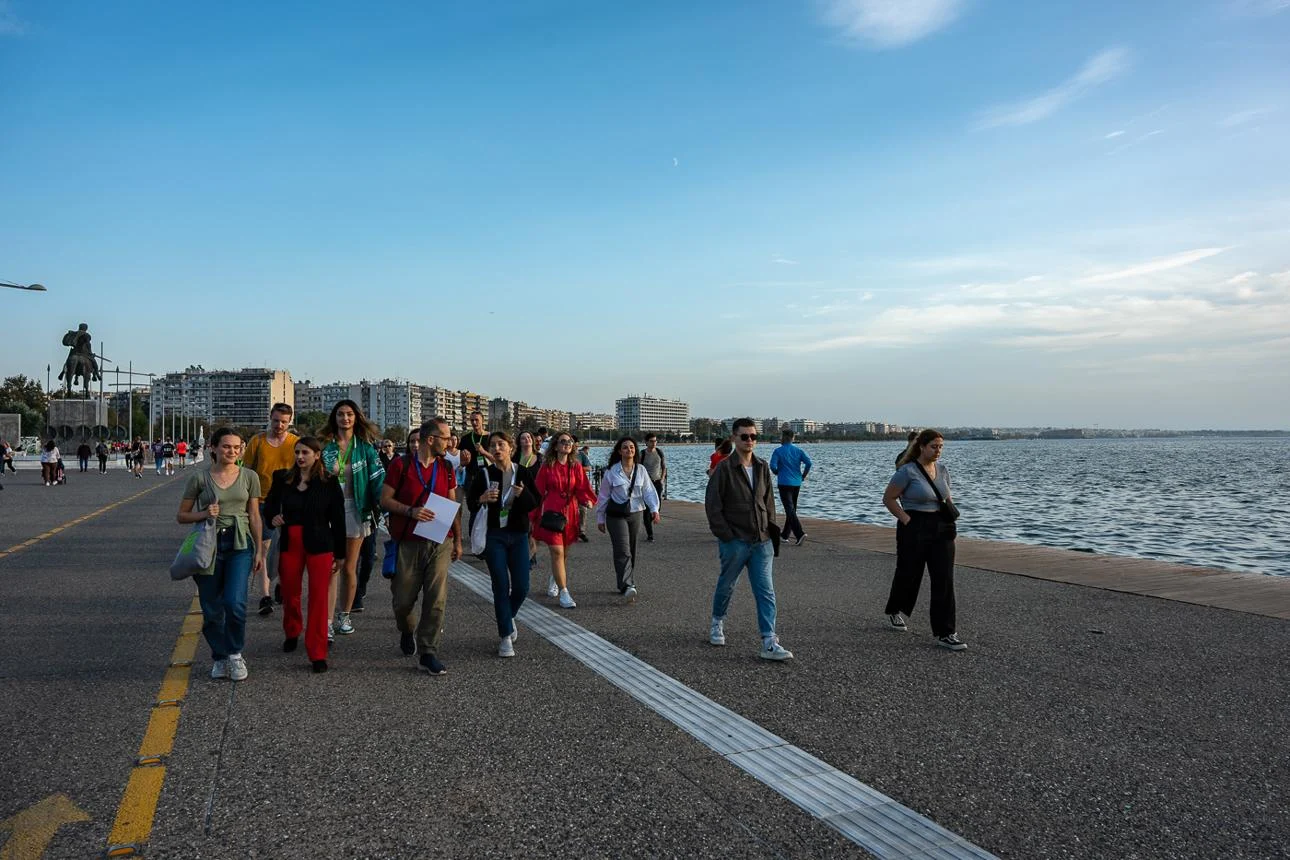
Moving to Greece is a dream that begins on holiday for many people. This guide shows honestly what really awaits you in everyday life, at public authorities, with taxes and with housing – and in which order you should prepare your fresh start.
Greece is easy to love on holiday. A coffee by the sea in the morning, dinner at a taverna in the evening, sunshine, good food, friendly people and the feeling that life runs a little more slowly.
And then, at some point, this thought appears: Why not actually live here?
For many people from Germany, Austria and Switzerland it does not stop at that thought. Some want to spend their retirement in Greece. Others work remotely, start a business or are looking for a new centre of life with their family. Others again do not want to emigrate completely at all, but to use Greece as a second home first.
All of that is possible. But there is one thing you should know from the very start.
Spending a holiday in Greece and living in Greece are two different things.
This is not a warning about Greece. Quite the opposite. If you know what to expect, you can avoid many typical mistakes and focus faster on the reason you actually came: a new life.
Greece does not have to be perfect to be the right country for you
If you come from Germany, Austria or Switzerland, you are used to certain procedures. You expect an authority to be able to say exactly which document is needed. You expect appointments, clear responsibilities, written confirmations and, ideally, one contact person.
In Greece a lot now works digitally and far better than a few years ago. Even so, everyday life can run differently. Sometimes an authority needs an additional document. Sometimes a document is interpreted differently than expected. And sometimes a process that looks very simple on paper leads through two or three different offices.
That is exactly why many people experience the first months after the move as the most demanding time. Not because Greece is a difficult country to live in. But because you are looking for a new home, organising documents, signing contracts, perhaps registering a car and sorting out insurance, while at the same time learning how everyday life in the new country actually works.
That takes time. And sometimes a little patience, too.

A holiday shows you Greece – but not necessarily everyday Greek life
Two weeks in a hotel or a holiday home can show you whether you like the landscape, the climate and the people. What they do not show you is how an ordinary Tuesday in January feels.
And that is exactly what matters before a permanent move:


What Greece offers in return
Of course nobody moves to Greece because of a tax number or a trip to a government office. The reasons lie elsewhere.
In many regions the climate makes outdoor living possible for a large part of the year. A coffee with friends, a walk by the sea or dinner outside are not only holiday activities – they become part of normal everyday life.
Social life often takes place more outside your own four walls. People meet, sit together, talk to each other and take their time doing it.
The pace is different in many areas as well. If you come from an environment where almost every day is planned out, it can take some getting used to. But many people discover a new quality of life in exactly that. Not everything has to get faster. Not everything has to get bigger. And not everything that makes up quality of life can be measured on a payslip.
That does not mean that life in Greece is cheap or free of worries. Rents, energy, imported products or particularly popular regions in particular can cost more than expected.
So the decisive question is less: Is Greece cheaper than Germany or Switzerland? The better question is: Does my income match the life I want to live in Greece?
For a pensioner with a secure pension the calculation looks different than for someone who wants to live solely on a Greek salary. For a remote worker it looks different again. And for a family, different once more.
Perhaps the most important point: sort out your status first
Before you rent a flat, order furniture or book the removal van, it should be clear how you are going to live in Greece. Are you an employee, self-employed, a pensioner or a digital nomad? Will you live in Greece permanently or only part of the year? Will your centre of life stay in your home country, or will Greece become your main residence?
For EU citizens, moving within the European Union is generally much easier. For a stay of more than three months, however, you are obliged in Greece to register with the competent police authority and to apply for a registration certificate. Which documents are required depends on whether you are employed, self-employed, retired or economically inactive. People who are not working usually have to prove sufficient financial resources and health insurance cover.
Swiss nationals also enjoy extensive rights of entry, residence and taking up employment or self-employment under the Agreement on the Free Movement of Persons between Switzerland and the EU. Even so, the practical steps should be checked before the move.
People from other non-EU countries may in turn need a visa or a special residence permit.
That is why there is no single plan for moving to Greece that works for everyone.

Main residence, second home and tax residence are not the same thing
A particularly common mistake is to mix up stay, residence and tax residency.
“I am in Greece for less than 183 days, so none of this affects me.” It is not that simple.
Besides the length of stay, tax residency also depends on your habitual residence and the centre of your personal and economic interests. The 183-day rule is therefore only one of several criteria.
Anyone staying in Greece permanently or for a large part of the year should clarify with a qualified tax adviser beforehand what consequences the move has in their personal situation. We support you in organising and coordinating these steps, but we do not replace tax advice.
This applies in particular to people who want to keep working for a company in Germany, Austria or Switzerland. “I will just take my laptop and work from Greece” sounds simple. Tax law, social security and the situation of the employer can make it more complicated, however.
Questions like these should not be sorted out only after you have already moved.
For some newcomers Greece can also be attractive from a tax perspective
In recent years Greece has introduced several schemes designed to attract new tax residents. Two of them are particularly interesting when moving to Greece:
Bureaucracy when moving to Greece: not always difficult, but often different
Greek public administration has become much more digital in recent years. Many things can now be done online. Even so, people who move here keep running into situations that seem confusing at first.
A document is missing. A translation is required. The bank needs proof you did not expect. A different office has different requirements. Or the order is wrong: for B you need A, for C you need B – and without C you cannot move forward somewhere else.
That is exactly why the right order matters so much when you move. The Greek tax number AFM, for example, is one of the central foundations of everyday life: it is needed for numerous contracts and procedures. Depending on your personal situation, topics such as the social security number AMKA, residence registration, the Greek bank account, housing, insurance, electricity, water and internet or the vehicle follow. From our daily work we know how closely these steps are connected.
How we would prepare a move to Greece
This order has proven itself in practice. It does not replace individual advice, but it does show what matters:
You do not have to speak perfect Greek – but you do need a way through the language
In many tourist regions and larger cities you get by well with English. A visit to an authority, a tax question, a contract or a case worker explaining something are a different situation, however.
Official documents are in Greek. And for important decisions it is not enough to roughly understand what is meant. Even small misunderstandings can cause a lot of work later on.
Learning Greek is therefore always worth it – not only for the authorities, but above all for really arriving in the country. But you do not have to wait until you speak perfect Greek. Especially at the beginning, a trustworthy local contact can be the bridge between the system you know from your home country and everyday life in Greece.
Good support does not mean promising you everything
If you are looking for help with your move, do not only look at a nice website or at whether someone speaks your language. Ask more specific questions:
For us, that is exactly a sign of professional work. A good contact does not have to do everything themselves. They have to know who can do what properly.
The goal should never be to keep the client dependent for as long as possible. The goal should be to explain the path so clearly that uncertainty turns into confidence, step by step.
And what about the famous Greek calm?
Some love it from day one. Others need a little longer.
If an appointment does not go as expected or an answer takes a little longer, it rarely helps to constantly compare Greece with Germany, Austria or Switzerland. “Back home this would be …” You can of course say that sentence every day. It usually does not make you any happier.
After all, you are not moving to Greece because you are looking for a second Germany there. You are moving to Greece because you have deliberately chosen something different.
That does not mean you should accept poor organisation or do without professional work. It only means that part of moving abroad is getting to know a different way of living and thinking. And for many people that later turns out to be one of the greatest advantages of their new life.
Maybe moving to Greece is exactly right for you
We do not want to tell anyone that the sun shines every day in Greece, that every authority works perfectly and that all problems disappear over a coffee by the sea. That would not be honest. But we believe just as little in the other extreme, according to which moving to Greece has to be complicated.
Greece can be a wonderful place to live. For pensioners. For families. For people who work remotely. For the self-employed. For people who want to start completely fresh. Or for those who simply want to spend part of their life here.
The decisive difference is often not whether problems come up. There are problems with almost every move – even within your own country. The difference is whether you know what to do when a question arises.
You can look forward to Greece. To the sun. To the sea. To the food. To new people. To a different rhythm. And to the feeling of one day no longer saying: “We are in Greece again.” But: “We are home.”
From the first idea to everyday life in Greece
That is exactly what we support you with. We live and work in Greece ourselves and accompany people who want to live here permanently or part of the time.
From the Greek tax number AFM and the social security number AMKA through residence questions and the bank account to property, electricity, water and internet, insurance and vehicle registration, we help you plan and carry out each step sensibly.
And if a tax adviser, lawyer, notary, engineer or another specialist is needed for a topic, we will tell you. Because our goal is not to sell you Greece as a perfect dream. Our goal is to turn your wish to live in Greece into a well-prepared plan.
Every starting situation when moving to Greece is different. Whether it is retirement, remote work, family, a second home or a completely fresh start – we help you take the right steps in the right order and find the right contacts for your situation.